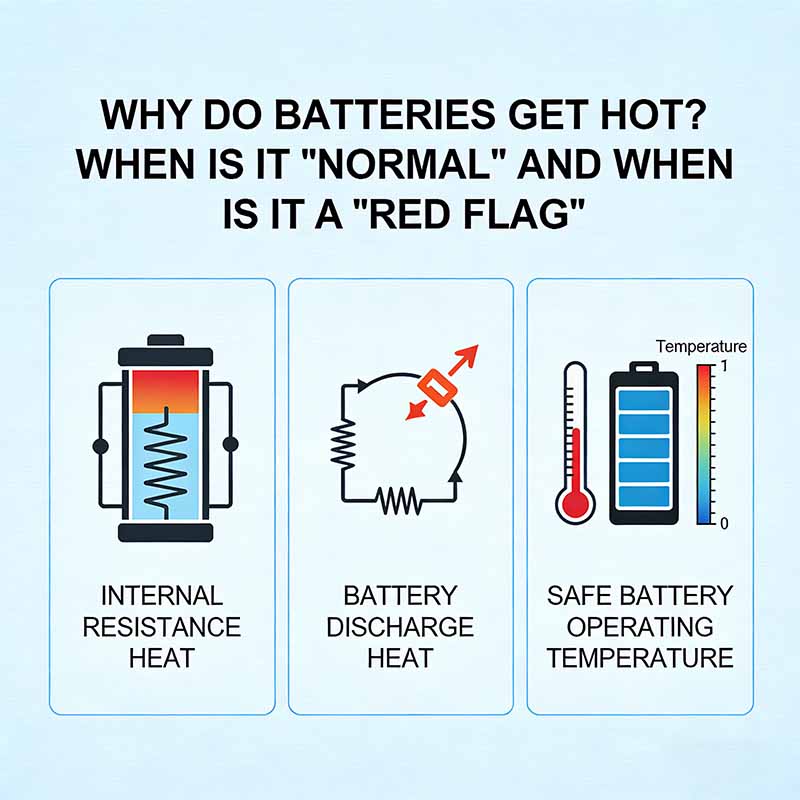
Why Do Batteries Get Hot? When is it “Normal” and When is it a “Red Flag”?
During operation, “heat” is the most common phenomenon in lithium batteries. Many users feel a surge of anxiety when they touch a warm battery pack: Is this high efficiency, or is it a warning sign of an impending failure?
In reality, battery heat is an inevitable byproduct of physics. However, there is a critical safety line between “warm” and “scalding.” Today, we will break down the four main causes of battery heat from an engineering perspective and teach you how to distinguish normal wear from dangerous signals.
■ Internal Resistance: The Source of Heat
No battery is a perfect, “zero-resistance” conductor. A lithium battery consists of electrolytes, separators, and electrode plates. As ions travel through these materials, they encounter resistance—this is Internal Resistance.
- Joule’s Law: According to the formula Q = I^2Rt, as current flows through internal resistance, a portion of electrical energy is inevitably converted into thermal energy.
- The Aging Factor: As a battery ages, its internal resistance increases. This means an old battery will generate significantly more heat than a new one while performing the exact same task.
📌 Think of it like this: > Imagine running down a hallway. If the hallway is empty (low internal resistance), you pass through easily. If the hallway is packed with people (high internal resistance), you have to push and friction-bump your way through, causing your body temperature to rise quickly.
■ Discharge Rate: The Price of Speed
As we’ve discussed with C-rates, the faster you discharge, the more heat you generate—and it grows exponentially.
- Double the Current, Quadruple the Heat: If you double the discharge current, the heat output increases by four times.
- Sustained High Loads: Lithium batteries can handle short “bursts” of high current, but if they are pushed at a high C-rate for long periods, heat accumulates inside the cells faster than it can escape.
📌 Think of it like this: > It’s like driving a car. At 40 mph, the engine stays cool and quiet. But if you push the car to 120 mph and keep it there, the engine bay will radiate intense heat, and you risk “redlining” or blowing a gasket.
■ Ambient Temperature: The Stacking Effect
A battery’s temperature is the sum of its “self-generated heat” and the “ambient temperature” of its environment.
- Clogged Heat Dissipation: If a battery operates in an environment above 40°C (104°F), the temperature difference between the battery and the air is too small for heat to escape efficiently.
- Chemical Degradation: High temperatures accelerate internal chemical reactions. While this might temporarily lower internal resistance, it speeds up the degradation of materials, creating a vicious cycle of “High Heat – Rapid Aging.”
■ Thermal Design: Structure is the Lifeline
A high-quality battery pack isn’t just designed to store power; it is designed to reject heat.
- Thermal Pathways: Are there air gaps between cells? Is high-conductivity silicone used to transfer heat to the outer casing?
- Casing Material: Metal enclosures (like aluminum alloy) dissipate heat much more effectively than plastic. Without proper thermal engineering, cells act like they are trapped in a thermos—the heat builds up even under light loads.
■ Summary: “Normal” vs. “Dangerous”
Use this quick guide to evaluate your battery’s health:
| Feature | Normal Phenomenon | Dangerous Red Flag |
|---|---|---|
| Touch Temperature | Warm (approx. 30°C – 45°C) | Scalding (>60°C); painful to touch |
| Odor | No smell | Pungent chemical or burning plastic smell |
| Appearance | Intact and clean | Swelling (bloating), warping, or cracks |
| Performance | Consistent power | Severe voltage drops or frequent shutdowns |
| Cooling Speed | Temperature drops quickly after use | Battery stays hot long after the load is removed |
⚠️ Pro Tip: If a battery feels hot during the charging phase, this usually indicates a serious cell imbalance or a faulty BMS. Disconnect the power immediately!
■ Optimize Your System’s Thermal Management
Safety comes from rigorous engineering. Poor thermal management doesn’t just shorten life; it threatens your equipment. We provide:
- Thermal Simulation: Predicting temperature distribution under extreme conditions during the design phase.
- High-Conductivity Materials: Optimizing internal structures to increase heat dissipation by over 30%.
- Active BMS Monitoring: Multi-point temperature sensing to intervene before a danger zone is reached.