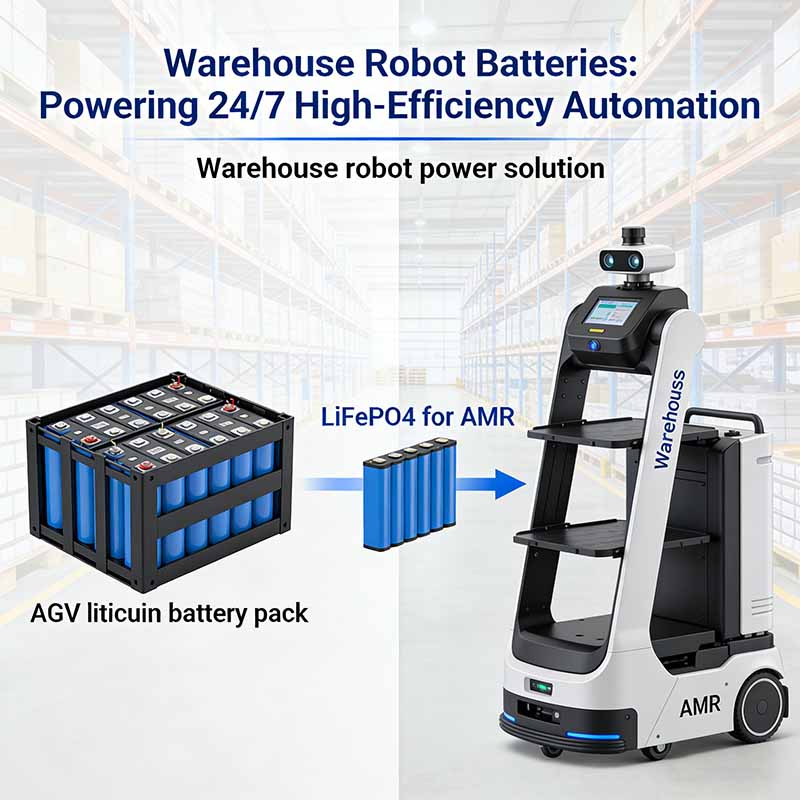
Warehouse Robot Batteries: Powering 24/7 High-Efficiency Automation
In modern logistics, AGVs (Automated Guided Vehicles) and AMRs (Autonomous Mobile Robots) are the backbone of throughput. The battery pack is the “blood” of these robots, directly determining whether your fleet is operational or sitting idle at a charging station.
When customizing lithium battery solutions for warehouse robotics, developers must balance energy efficiency, replenishment speed, and long-term Total Cost of Ownership (TCO).
■ Battery Strategies for 24/7 Operations
To support three-shift continuous operations, logistics robots typically follow one of two power strategies:
- Opportunity Charging (Shallow Cycling): Robots utilize short idle periods—such as during task assignment or at a pickup station—for 5-10 minute rapid charging sessions. This requires cells with exceptional charge acceptance that won’t degrade under high-frequency cycling.
- Long-Endurance High Capacity: For scenarios where charging is infrequent, robots carry larger packs to achieve 8-10 hours of continuous runtime. Here, energy density and weight distribution become the primary design drivers.
■ Fast Charging, Swapping, and Safety Management
Replenishment speed is the lifeline of logistics. Different methods impose specific demands on battery design:
- High-Rate Fast Charging:
- Industrial robots often require 1C or even 2C+ charging rates.
- Design Key: Cells must be specifically rated for high-current charging. The BMS must monitor temperature gradients in real-time to prevent heat buildup from affecting cell consistency.
- Modular Battery Swapping:
- For extreme-intensity environments, swapping provides “near-zero” downtime.
- Design Key: The battery enclosure must feature high-reliability blind-mate connectors (such as Anderson or specialized floating connectors) rated for thousands of mating cycles.
- Charging Safety Interlocks:
- Warehouse charging is usually unattended. The BMS must communicate with the charger (via CANbus or RS485) to ensure immediate disconnection in case of overvoltage, overheating, or communication loss.
■ High Cycle Life: The Core of TCO Reduction
Logistics robots are significant capital investments. The battery’s lifespan is the most critical factor in your long-term return on investment:
- The LiFePO4 Advantage: In warehouse robotics, Lithium Iron Phosphate (LFP) is the gold standard. It offers 3,000 to 6,000+ cycles, providing over 5 years of service even under heavy use.
- Internal Resistance Management: Low-resistance design minimizes energy loss during charge/discharge cycles, reducing heat generation and preserving chemical health.
- High-Current Balancing: For large-capacity packs, the BMS must have a higher balancing current to correct voltage deviations caused by repeated high-speed charging.
■ Environmental Resilience: Cold Chain & Dust
Logistics environments are often harsh, requiring specialized battery engineering:
- Cold Chain Logistics (Down to -30°C): For AGVs in cold storage, battery packs must include integrated heating elements and thermal insulation. The BMS must ensure cells are pre-heated before charging to prevent lithium plating and irreversible damage.
- Industrial Dust & Protection: Warehouses are prone to dust. Battery packs usually utilize ruggedized sheet metal enclosures with IP54 ratings or higher to prevent particulates from causing internal shorts.
■ Summary: Selection Logic for Warehouse Robots
- For Maximum Asset Utilization: Prioritize LiFePO4 systems supporting 2C fast charging and ensure the BMS is optimized for seamless communication with automated charging stations.
- For Cold Storage Operations: Require a custom pack with self-heating functionality and low-temperature electrolyte formulas.
- For Simplified Maintenance: Utilize a Smart BMS with Cloud Monitoring to track State of Health (SOH) in real-time, enabling predictive maintenance before a failure occurs.
■ Expert Technical Support for Logistics Robotics
Our engineering team understands the rigors of the warehouse floor. We provide:
- Custom CAN/RS485 communication interfaces compatible with mainstream flight and drive controllers.
- High-consistency cell matching for 24/7 operational reliability.
- Structural simulation to ensure battery integrity under frequent acceleration and vibration.
→ Contact Our Robotics Application Engineers for Technical Support