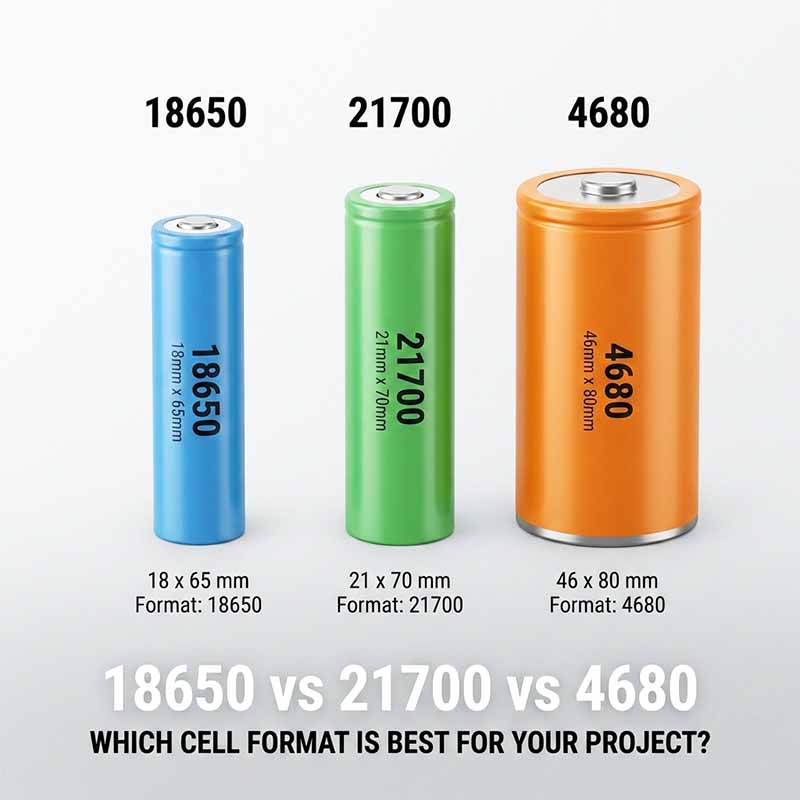
18650 vs 21700 vs 4680: Which Cell Format Is Best for Your Project?
When designing a lithium battery pack, choosing the right cylindrical cell format is the first major engineering hurdle. From the classic 18650 to the high-performance 21700 and the revolutionary 4680, these numbers represent more than just physical dimensions—they dictate energy density, thermal efficiency, and manufacturing costs.
Let’s break down these three mainstream formats to find the “optimal solution” for your specific application.
■ 18650: The Timeless “Reliable Veteran”
The 18650 (18mm diameter, 65mm length) is the pioneer of modern cylindrical batteries.
- Why is it the most common? Maturity. Its production is the most highly automated, its supply chain is incredibly stable, and because of its small individual capacity, it offers unparalleled flexibility for packing into irregular spaces.
- Best for: Laptops, power tools, medical devices, and projects where space utilization is tight or unconventional.
📌 The Analogy: > Think of 18650 cells like “standard red bricks.” Because they are small, you can use them to build a wall of almost any shape. They are universal and reliable.
■ 21700: The “Golden Ratio” of Performance
The 21700 (21mm diameter, 70mm length) is only slightly larger than the 18650, but it delivers roughly 50% more energy output.
- Why is it trending? It strikes the perfect balance between energy density and system cost. Switching to 21700 cells reduces the total cell count needed for a pack, which means fewer BMS monitoring points and fewer weld joints, significantly improving overall system reliability.
- Volumetric Efficiency: It generally offers higher energy density than the 18650, allowing you to pack more “juice” into the same footprint.
■ 4680: The “Monster” Built for Scale
The 4680 (46mm diameter, 80mm length) is currently the ceiling of cylindrical cell design.
- Volumetric Efficiency: One 4680 cell has about 5.5 times the volume of a 21700. Using these massive cells drastically reduces the number of structural components and boosts the pack’s overall energy density.
- Technological Core: To solve the heat and resistance issues inherent in such a large cell, 4680s typically use “Tabless” technology, which exponentially shortens the path electrons have to travel.
■ Thermal Management: Is Bigger Always Harder to Cool?
Thermal management is the primary bottleneck in cell sizing.
- Small Cells (18650): These have a high surface-area-to-volume ratio. They dissipate heat quickly, making it harder for heat to build up inside the pack.
- Large Cells (4680): A large cell acts like a giant thermos. Heat generated in the center struggles to reach the outer casing. Without advanced cooling (like serpentine liquid cooling or tabless designs), large cells can degrade quickly due to internal “hot spots.”
📌 The Analogy: > An 18650 is like a small cup of hot water—it cools down in minutes. A 4680 is like a giant pot of soup; even if the outside feels warm to the touch, the center could still be boiling.
■ Pack Structure: From “Legos” to “Integration”
Cell size directly influences your Battery Pack design logic:
- Part Count: For a 100kWh pack, you need about 7,000 cells if using 18650s, but only about 900 if using 4680s. Fewer weld points equal a lower system failure rate.
- Structural Integrity: Since 21700 and 4680 cells are much heavier, they require stronger brackets and high-strength structural adhesives to handle industrial-grade vibrations.
- Space Flexibility: If your device has a narrow or odd-shaped battery compartment, 18650 is still the winner. If you want maximum lightweighting and low mass-production costs, 4680 or 21700 is superior.
■ Summary: Choosing Your Optimal Format
There is no “perfect” size, only the right fit for your specific requirements:
- Choose 18650 if you prioritize flexibility, maturity, and proven reliability in tight spaces.
- Choose 21700 for high-performance applications that demand high energy density and balanced costs.
- Choose 4680 for massive-scale projects, integrated structural batteries, and minimized part counts.
■ Expert Cell Selection & Pack Design Support
Choosing the wrong cell format can lead to thermal failure or structural headaches down the road. We provide a comprehensive analysis based on your space constraints, cooling budget, and power needs.
- Energy density comparison charts for different cell formats.
- Pack structural optimization and vibration testing reports.
- Thermal simulation and cooling system design.