Ah vs Wh: Why Comparing Lithium Batteries by Ah Alone Can Be Misleading
In lithium battery selection, Ah (ampere-hours) and Wh (watt-hours) are often the first specifications discussed—
and also the two most commonly misunderstood.
It’s very common to hear engineers or buyers say:
“I need a 20Ah lithium battery.”
At first glance, this sounds specific.
In reality, it leaves out critical information.
Because in a lithium battery system:
-
Ah does not represent actual energy
-
The same Ah can mean very different energy levels under different voltages or S/P configurations
-
Only Wh truly reflects how much usable energy a battery can deliver
To compare lithium battery capacity correctly, you must understand Ah, Wh, and how series and parallel connections affect them.
■ Ah vs Wh: What’s the Real Difference?
Ah (Ampere-hour) describes how much current a battery can deliver over time:
1Ah = 1A × 1 hour
It represents:
-
Current capability × time
-
Without considering voltage
Wh (Watt-hour), on the other hand, measures the actual energy stored in the battery:
Wh = Voltage × Ah
It represents:
-
Voltage × current × time
-
The key metric for runtime estimation, power matching, and system-level comparison
The takeaway is simple:
👉 Ah cannot be compared without voltage
👉 Wh is the universal language for comparing battery capacity across systems
■ How Series and Parallel Connections Change Ah and Wh
In lithium battery packs, how Ah and Wh change depends entirely on whether cells are connected in series or in parallel.
Understanding this is essential to avoid capacity misjudgment.
For a detailed explanation of battery configurations, see:
Battery Series & Parallel
Series Connection: Higher Voltage, Same Ah
When cells are connected in series (S):
-
System voltage increases with the number of cells
-
Ah remains unchanged
Example with identical cells:
-
Single cell: 3.7V / 5Ah
-
2S configuration:
-
Voltage: 3.7V × 2 = 7.4V
-
Capacity: 5Ah
-
Energy: 7.4V × 5Ah = 37Wh
-
This shows that:
-
Series connection does not increase Ah
-
But higher voltage results in a proportional increase in Wh
👉 The primary purpose of series connection is to raise system voltage and total energy
Parallel Connection: Higher Ah, Same Voltage
When cells are connected in parallel (P):
-
System voltage stays the same
-
Ah adds up with each parallel cell
Using the same 3.7V / 5Ah cells:
-
2P configuration:
-
Voltage: 3.7V
-
Capacity: 5Ah × 2 = 10Ah
-
Energy: 3.7V × 10Ah = 37Wh
-
Here:
-
Parallel connection increases Ah
-
Wh also increases, but through a different mechanism
👉 The main role of parallel connection is to increase available current and runtime
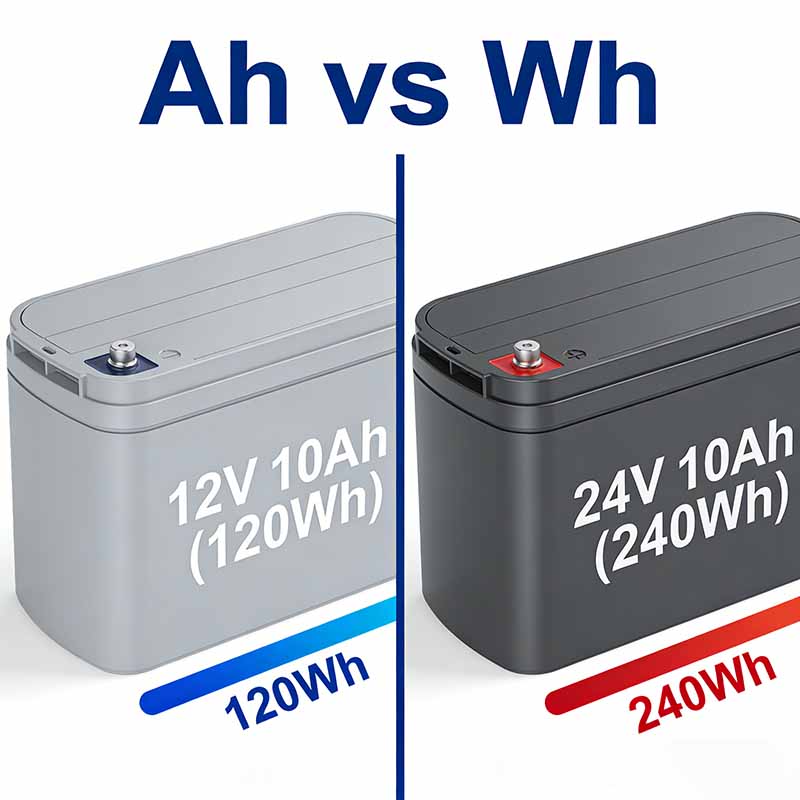
Why Wh Is the Only Fair Way to Compare Battery Capacity
If you compare batteries by Ah alone, incorrect conclusions are almost inevitable.
For example:
-
Battery A: 12V / 10Ah → 120Wh
-
Battery B: 24V / 10Ah → 240Wh
Although both are rated at 10Ah:
-
Battery B stores twice the energy
-
At the same load power, its runtime will be roughly twice as long
This explains why batteries with the same Ah rating can deliver very different runtimes.
Once system voltage differs, Ah alone no longer provides a meaningful comparison.
■ How Ah and Wh Are Used in Real Battery Selection
In practical engineering applications, a simple rule applies:
-
Ah
-
Used for individual cell specifications
-
Parallel configuration design
-
Current and C-rate calculations
-
-
Wh
-
Used for comparing battery solutions
-
Runtime estimation
-
Evaluating systems with different voltages
-
Quotation, transportation, certifications, and datasheets
-
👉 In B2B applications, Wh is usually the final decision-making metric
■ Beyond Ah and Wh: System Design and BMS Matter
Even if two battery packs have the same Wh rating, their usable energy can still differ due to:
-
BMS current or power limits
-
Different cut-off voltage settings
-
Cell consistency in series/parallel configurations
-
Operating temperature and aging conditions
This is why, in real-world applications,
a battery pack is never just a collection of numbers—it’s a system-level design.
■ Summary: Don’t Compare Lithium Batteries by Ah Alone
-
Ah represents current capacity, not energy
-
Series connections increase voltage; parallel connections increase Ah
-
Wh is the only reliable metric for cross-voltage and cross-system comparison
-
Proper battery selection must consider:
-
System voltage
-
Series/parallel configuration
-
BMS design
-
Actual application requirements
-
■ Don’t Want to Deal with the Math? We Can Handle It for You
If you’d rather not spend time on
Ah vs Wh, voltage calculations, or series/parallel configurations,
but still need a safe, reliable, and scalable lithium battery solution—
We provide end-to-end support from:
requirement definition → solution design → sample validation → mass production.
Tell us your application scenario.
We’ll take care of the calculations and engineering details.