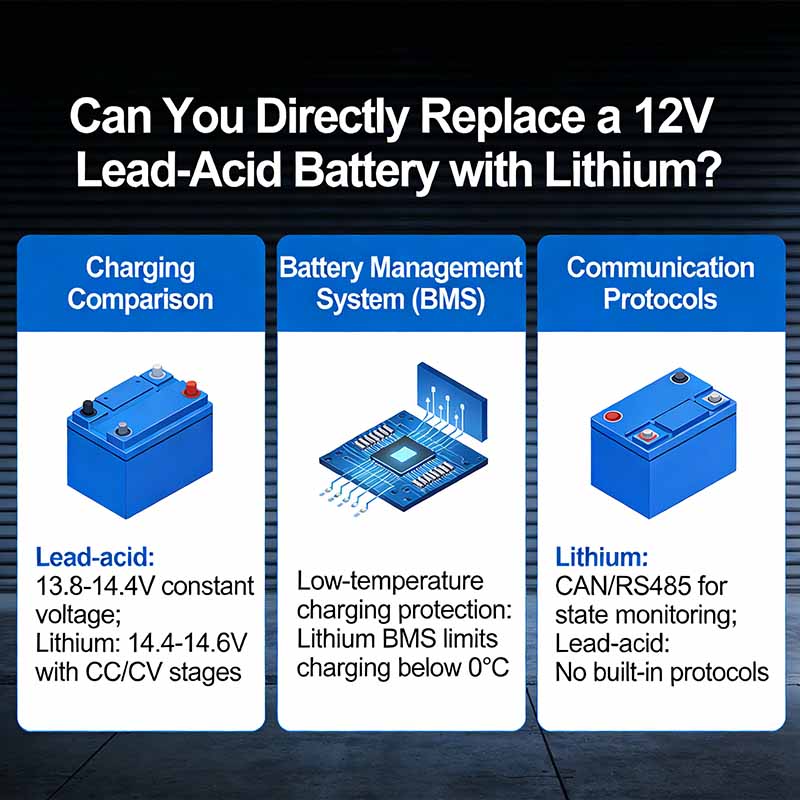
Can You Directly Replace a 12V Lead-Acid Battery with Lithium?
As the world shifts toward cleaner energy, many users have a simple wish: “Since they are both 12V, can I just swap my heavy lead-acid battery for a lightweight lithium one, like changing a lightbulb?”
While the voltage on the label might match, their “personalities” and operating requirements are worlds apart. A direct “drop-in” replacement without adjusting your system often leads to a halved lifespan or even equipment damage. Here are the four critical reasons why a swap isn’t always simple.
■ Charging: Different “Dietary Habits”
Lead-acid and Lithium (specifically LiFePO4) batteries follow completely different charging logics.
- Lead-Acid: These are like “big eaters.” They prefer a multi-stage charging process (Bulk, Absorption, Float) and are quite forgiving of voltage fluctuations.
- Lithium: These require “precision feeding.” They use a Constant Current/Constant Voltage (CC/CV) curve. If you use an old lead-acid charger, it might try to “Float” charge the battery even when it’s full, putting the lithium cells under constant high-voltage stress.
📌 Think of it like this: A lead-acid battery is like a competitive eater—it doesn’t mind a few extra calories here and there. A lithium battery is like a world-class athlete; it needs a very specific, strict diet (charging curve) to perform. If you overfeed it, it gets “sick” (cell damage) very quickly.
■ BMS Logic: The “Safety Fuse” Factor
Lead-acid batteries are “old school.” When they run out of power, the voltage drops slowly. Your equipment just gets slower and slower until it eventually stops. Lithium batteries, however, come with a “brain”—the BMS (Battery Management System).
- Instant Cut-off: To protect the cells, the BMS will instantly kill the power if the voltage gets too low or the current gets too high.
- The Shutdown Risk: If your equipment isn’t calibrated for lithium, it might trigger a sudden BMS shutdown while you still think you have 10% power left, causing your entire system to go dark without warning.
📌 Think of it like this: A lead-acid battery is like a dying candle; the flame flickers and gets smaller, giving you time to find a flashlight. A lithium battery is like a modern circuit breaker; once a limit is hit, it’s “CLICK”—the lights are out instantly.
■ Cold Weather: The “Freezing Trap”
This is a major survival difference. Lead-acid batteries can still be charged in sub-zero temperatures, even if their performance dips.
- The Lithium Taboo: Most lithium batteries cannot be charged below 0°C (32°F). Attempting to force a charge in freezing temperatures causes “Lithium Plating,” which creates permanent internal shorts and can even lead to fires.
- Replacement Risk: If you swap batteries in an outdoor device but keep your old charger that lacks temperature sensors, the first snowstorm of the year could permanently destroy your new battery.
📌 Think of it like this: A lead-acid battery is like a rugged outdoorsman; he can still work in the freezing cold. A lithium battery is like a high-tech smartphone; it works great in the sun, but if you force it to “eat” (charge) in the snow, it will literally freeze up and break.
■ Communication: From “Islands” to “Networks”
Traditional lead-acid systems are “dumb.” The charger just pumps in power without knowing what the battery is actually feeling.
- Smart Interconnection: Modern industrial lithium systems often require a “handshake” with the charger or inverter via CAN or RS485 protocols. The battery actively tells the charger: “I’m getting too hot, slow down,” or “I’m 100% full, stop now.”
- The Missing Link: A simple swap usually means losing this intelligent communication. The charger stays blind to the battery’s health, significantly increasing the risk of long-term failure.
📌 Think of it like this: A lead-acid system is like an old AM radio—you set it and leave it. A lithium system is like a modern 5G smartphone; it needs to be “connected” to stay smart. If you cut the connection, you lose all the advanced safety and performance features.
■ Summary: An Upgrade is a “System Project”
Upgrading from 12V lead-acid to lithium is a brilliant long-term investment, but it requires a system-wide approach.
- Check the Charger: Ensure it has a dedicated “Lithium Mode” or a CC/CV profile.
- Evaluate the Environment: If you operate in cold climates, choose batteries with internal heating or low-temp charge protection.
- Match the Load: Ensure the lithium BMS can handle the peak startup currents of your existing equipment.
■ Get Expert Advice on Your Battery Upgrade
A blind replacement can result in unnecessary costs. We can evaluate your current charging setup and load requirements to ensure a smooth, safe transition to lithium.
- Get a compatibility checklist for lead-acid to lithium transitions.
- Explore battery solutions with built-in self-heating for cold climates.
- Customize industrial-grade packs with integrated communication protocols.