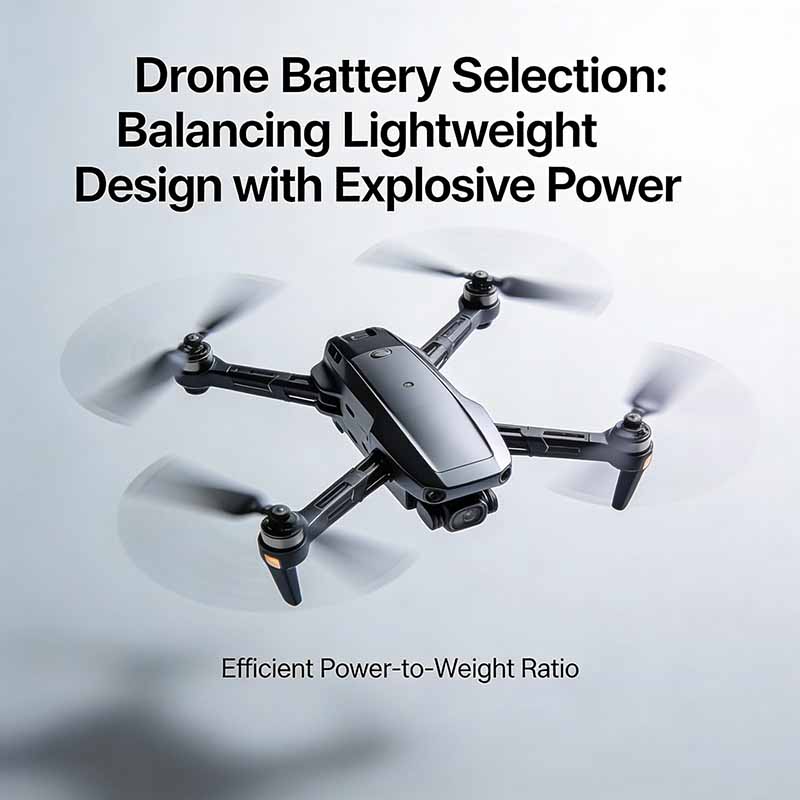
Drone Battery Selection: Balancing Lightweight Design with Explosive Power
In the world of UAV (Unmanned Aerial Vehicle) design, the battery is more than just a fuel tank—it is a “critical payload” that dictates flight performance. Unlike ground-based equipment, drones demand extreme weight efficiency while requiring massive current bursts for takeoff, hovering, and high-speed maneuvers.
Customizing a battery pack for drones is a high-stakes challenge involving high-rate discharge, energy density, and flight safety.
■ High Discharge Rates: The Source of Power
When a drone accelerates or fights strong winds, its motors demand an immediate surge in current. This requires a battery with exceptional C-Rate performance:
- Instantaneous Burst Power: Industrial or FPV (First Person View) drones typically require 10C, 25C, or even higher continuous discharge rates. If the discharge rate is insufficient, the battery will suffer from “Voltage Sag” under load, leading to a loss of power or even a mid-air crash.
- Low Internal Resistance (IR): To support high-current discharge without generating excessive heat, cells must have extremely low IR. This is achieved through specialized tab designs and advanced electrochemical formulas.
■ Weight vs. Endurance: The Art of Thrust-to-Weight Ratio
In drone engineering, every extra gram of battery weight directly consumes a portion of the motor’s lift.
- Energy Density (Wh/kg): Drones typically utilize Lithium Polymer (Li-Po) or high-energy density NCM cells. The industry benchmark is currently pushing beyond 250Wh/kg at the system level.
- The Law of Diminishing Returns: A bigger battery isn’t always better. Once the battery weight exceeds a certain percentage of the drone’s total mass, the gain in runtime is offset by the energy required to lift the extra weight, ultimately reducing maneuverability and motor lifespan.
📌 Engineering Tip: For long-endurance inspection drones, we recommend keeping the battery weight between 30% and 45% of the total takeoff weight. By using High-Voltage (LiHV) cells (4.35V or 4.4V), you can increase runtime by 10-15% without adding a single gram of weight.
■ Overcoming Challenges: Smart BMS & Thermal Management
Drone batteries operate under extreme stress; a smart management system is the final line of defense for flight safety:
- Dynamic SOC Algorithms: Drones require highly accurate State-of-Charge (SOC) data. The BMS must combine current integration with voltage compensation algorithms to provide precise data at the “return-to-home” critical point, preventing sudden power failure.
- High-Current Thermal Management: High-rate discharge generates significant heat. Professional packs utilize high-conductivity materials and wind-facing air ducts to leverage airflow during flight for forced convection cooling.
■ Safety & Compliance: Global Standards
Due to their high energy density and volatile nature, drone batteries must adhere to strict international standards for trade and operation:
- UN 38.3 Certification: This is the mandatory “passport” for shipping lithium batteries by air or sea. it includes eight rigorous tests, including altitude simulation, thermal cycling, and vibration.
- UL 2271 / UL 2580: For commercial-grade drones, these certifications prove the battery will not explode or catch fire even under single-point failure or extreme physical damage.
- Storage Mode Protection: A smart BMS should feature a “Storage Mode” that automatically discharges the battery to an optimal voltage (approx. 3.8V – 3.85V) during long periods of inactivity to prevent swelling and capacity loss.
■ Summary: Selection Guide for Drone Operators
- For Maximum Flight Time (e.g., Mapping, Inspection): Prioritize High Energy Density and LiHV (High Voltage) cells while strictly controlling the total weight of the housing and cables.
- For High Responsiveness (e.g., Racing, Stunts): Opt for Ultra-High Rate (35C+) cells to ensure voltage stability, even if it means sacrificing some total capacity.
- For Extreme Climates: Ensure your battery pack includes a low-temperature self-heating function to prevent voltage drops when flying in freezing conditions.
■ Get Professional UAV Power Solutions
Drone battery customization requires deep expertise in electrochemistry and structural engineering. Our team provides:
- Discharge curve analysis tailored to your flight profiles (Hover vs. Cruise).
- Lightweight housing designs using carbon fiber or high-strength composites.
- Smart BMS communication compatible with mainstream flight controllers.
→ Contact Our UAV Application Engineers for Technical Support