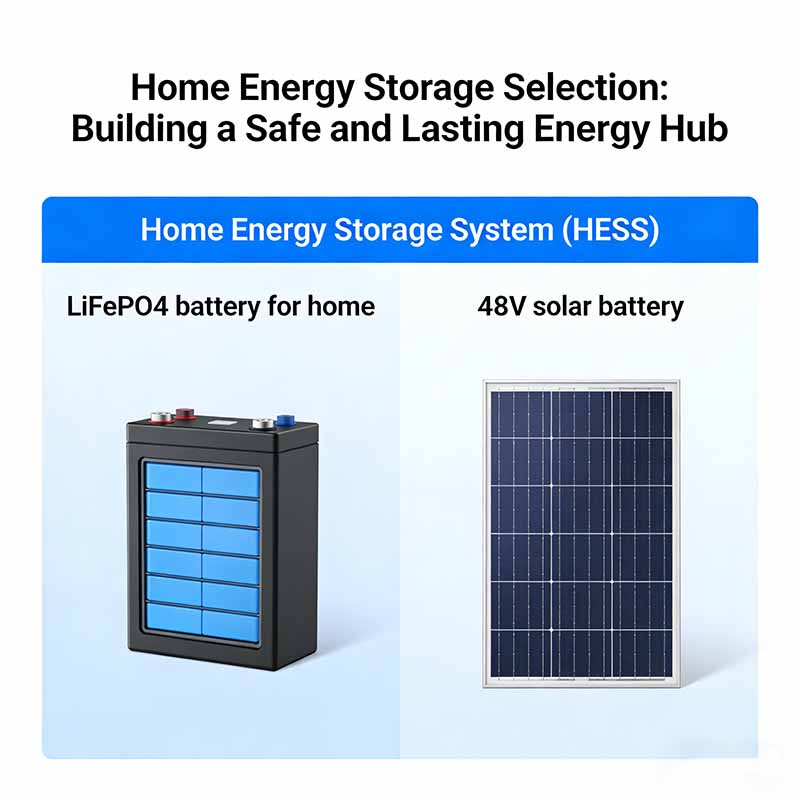
Home Energy Storage Selection: Building a Safe and Lasting Energy Hub
With rising energy costs, Home Energy Storage Systems (HESS) have become the key to achieving “energy independence.” Whether paired with solar panels for self-consumption or used as an emergency backup, your choice of battery pack directly dictates the system’s safety and your return on investment (ROI).
For homeowners, a storage battery is no longer just an industrial component; it is a household appliance that lives in your indoor space or garage. Therefore, selection should focus on: reliability, ease of maintenance, and intelligent management.
■ Two Core Forms of Residential Storage
Depending on your space and power requirements, home storage typically utilizes one of two cell architectures:
- 18650/21700 Cylindrical Packs:
- Characteristics: Highly mature technology with excellent consistency.
- Advantages: Ideal for custom or irregular dimensions. By using multiple parallel strings, it allows for flexible capacity scaling and simpler cooling channel designs.
- Prismatic Cells (Large Capacity):
- Characteristics: Large individual cell capacity (e.g., 50Ah, 100Ah, 280Ah) with fewer total components.
- Advantages: Superior space utilization and fewer connection points, which reduces internal resistance and potential failure points. This is the current mainstream for wall-mounted and stacked home ESS.
■ Capacity Planning: A Tailored Approach
When it comes to home storage, “bigger” isn’t always “better.” Effective planning should be based on your household’s average daily consumption:
| Planning Metric | Entry-Level Backup (2.5kWh – 5kWh) | Whole-Home Balance (10kWh – 20kWh) |
|---|---|---|
| Typical Use | Essential lighting, Routers, Refrigerator | Air conditioning, Water heaters, Full appliances |
| Architecture | 12V / 24V / 48V Systems | 48V (Low Voltage) or 200V+ (High Voltage) |
| Installation | Portable or small wall-mount | Stackable modules or server rack |
| Expansion | Reserved parallel ports for future add-ons | Modular “Plug-and-Play” design |
📌 Implementation Tip: For residential settings, LiFePO4 (Lithium Iron Phosphate) is the only recommended chemistry. While NMC is lighter, LiFePO4 offers over 6,000 cycles (10+ years of use) and an extremely low risk of thermal runaway, which is vital for home safety.
■ BMS: The “Safety Sentry” for Your Home
Since home ESS usually operates unattended, the intelligence of the Battery Management System (BMS) is paramount:
- Active Safety Defense: Must include protection against overcharge, over-discharge, over-current, and dual-layer temperature monitoring (cell + PCB). In the event of an anomaly, it must disconnect the current in milliseconds.
- Inverter Communication: A home BMS should support RS485 or CANbus communication to sync seamlessly with mainstream inverters (e.g., Victron, Pylontech protocols). This allows users to monitor precise battery levels via a smartphone app.
- Cell Balancing Technology: Home storage often remains in a “shallow” charge/discharge state, which can lead to voltage imbalances. An efficient balancing function ensures every cell works at full capacity, extending the pack’s life by over 20%.
■ Practical Challenges: Installation & Environment
The design of a home battery pack must address the pain points of real-world installation:
- Minimalist Installation: To prevent errors by non-professionals, battery packs should use polarized, “anti-reverse” terminals (such as Rema or dedicated ESS connectors) to eliminate short-circuit risks during setup.
- Low-Temperature Protection: If the battery is installed in an unheated garage in a cold climate, a BMS with a self-heating function is essential. Charging LiFePO4 cells below 0°C (32°F) causes irreversible chemical damage.
- Silent Operation: Prioritize passive cooling designs (using aluminum alloy casings for heat dissipation) to avoid fan noise disrupting family life.
■ Summary: Selection Logic for Home ESS
- If you seek high cost-performance and have limited space: Opt for a compact pack customized with high-quality 18650 cells.
- If you require large capacity (10kWh+): Prioritize Prismatic cells for their structural stability and lower long-term maintenance costs.
- If you plan to scale up later: Ensure you choose a Parallel Ready modular system where the BMS supports automatic address assignment.
■ Professional Support for Home Energy Storage
Safety is non-negotiable in residential energy. Our engineering team provides end-to-end solutions from cell grading to final assembly:
- Custom Smart BMS compatible with specific inverter protocols.
- Aesthetic and functional housing design (Sheet metal or Injection molding).
- Depth of Discharge (DOD) optimization for maximum battery longevity.