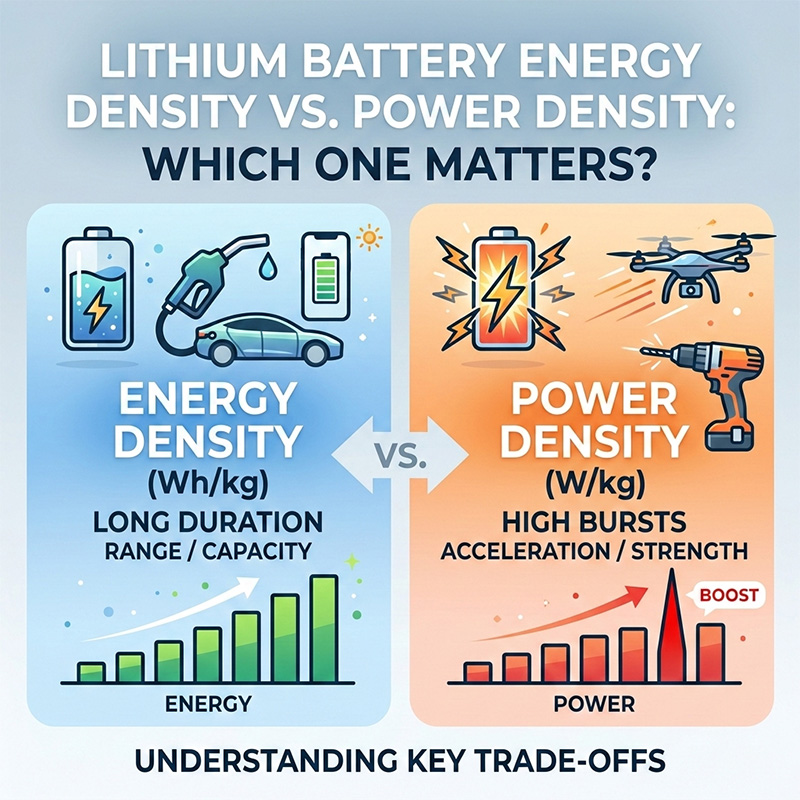
Lithium Battery Energy Density vs. Power Density Which One Matters
When selecting a lithium battery, you will frequently encounter two critical technical metrics: Energy Density (Wh/kg) and Power Density (W/kg).
Many customers ask: “Can I have a battery that lasts forever AND provides massive explosive power?” While that sounds ideal, the laws of battery chemistry often make this a trade-off. Understanding these two concepts is the first step in avoiding a costly project failure.
■ What is Wh/kg? (Energy Density)
Energy Density (Wh/kg) measures how much “energy” a battery can store per unit of weight. This determines how long your device can run—essentially, the battery’s endurance.
- High Energy Density Batteries: These are packed with as much active material as possible. The electrode coatings are thick and dense.
- Applications: Solar energy storage, long-duration sensors, long-range e-bikes (focused on distance).
📌 The Analogy:
Energy density is like a car’s “Fuel Tank Capacity.” The larger the tank, the more fuel you carry, allowing you to drive from City A to a distant City B without stopping to refuel.
■ What is W/kg? (Power Density)
Power Density (W/kg) measures a battery’s ability to release energy instantly. This determines how much “explosive power” your device can generate.
- High Power Density Batteries: To move current quickly, the electrode coatings are usually thinner and designed with more conductive agents and tabs (the “highway lanes” for electricity). This extra hardware takes up space that would otherwise hold energy.
- Applications: Jump starters, racing drones, industrial robots with frequent stops/starts, and Hybrid Electric Vehicles (HEV).
📌 The Analogy:
Power density is like the “Fuel Pipe Thickness.” Even if you have a massive fuel tank, if your fuel pipe is as thin as a drinking straw, the engine won’t get enough fuel to generate a massive burst of speed.
■ Energy vs. Power: The Core Difference
Based on these two metrics, lithium batteries are generally divided into two camps:
- Energy Cells (Storage): These focus on maximizing Wh/kg. They are like marathon runners—steady, reliable, and capable of working at a constant pace for a long time. If you force them to release a massive current, they will overheat and shut down.
- Power Cells (Performance): These focus on maximizing W/kg. They are like sprinters—capable of delivering huge bursts of current instantly. While their runtime might be shorter, they maintain stable voltage even under heavy loads.
■ Why Can’t I Just Pick “Both”?
This is a physical limitation of battery chemistry:
- For High Energy Density, you need thick electrodes. But thick electrodes increase internal resistance, making it harder for ions to exit quickly (low power).
- For High Power Density, you need thin electrodes and more exit paths. This leaves less room for the active materials that store energy (low capacity).
📌 The Analogy:
It’s like training an athlete. A Bodybuilder (High Power) has explosive strength but tires easily due to muscle weight and oxygen demand. A Marathoner (High Energy) can walk 20 miles without breaking a sweat, but if you ask them to squat 500 lbs (High Power Load), they might collapse instantly.
■ Summary: An Engineering Perspective
When designing your project, follow this logic:
- Determine Runtime: If the device needs to run for 10+ hours at a steady pace, prioritize Energy Density (Wh/kg).
- Determine Peak Load: If the device has violent current spikes (like high starting torque), you must choose High Power Density cells.
- The Compromise: For many industrial applications, we choose a balanced cell and increase the number of cells in parallel to share the current load, effectively gaining both capacity and power.
■ Get a Professional Energy Balancing Solution
Chasing only one metric often leads to systems that overheat or run out of juice too soon. We provide:
- Load Modeling: Precisely calculating the Wh (Capacity) and W (Power) your application truly needs.
- Chemistry Comparison: Selecting between LFP or NMC systems based on your goals.
- Pack-Level Optimization: Reducing system resistance through superior busbar and structural design.
→ Contact Our Application Engineers for a Custom Energy Solution