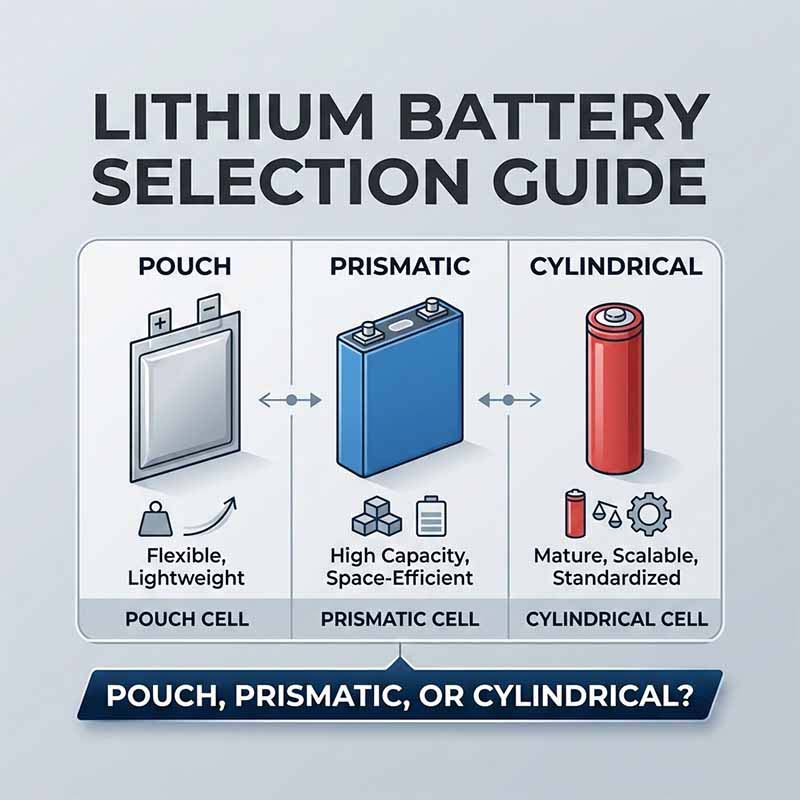
Lithium Battery Selection Guide: Pouch, Prismatic, or Cylindrical?
When developing a lithium battery project, choosing the right cell format is just as critical as selecting the chemistry (like LFP or NMC). Today, the industry is dominated by three main form factors: Cylindrical, Prismatic, and Pouch cells.
None of them is “the best” in a vacuum; there is only the “most suitable” for your specific application. In this post, we break down the engineering differences between these three structures.
■ Cylindrical Cells: The “Standardized Essential”
Cylindrical cells (such as the 18650 and 21700) are the most mature and standardized format in the industry.
- Structural Strength: Extremely High. The circular casing acts as a natural pressure vessel, allowing it to withstand significant internal pressure without deforming.
- Manufacturing Cost: Due to the massive scale of automated production, the cost per cell is the lowest, and the consistency between units is excellent.
- The Downside: When stacking multiple cylinders, there is inevitable “dead space” between them, leading to lower overall volumetric efficiency in a battery pack.
📌 The Analogy: Cylindrical cells are like “Soda Cans.” They are rugged, produced by the billions on high-speed lines, and follow global standard specifications.
■ Prismatic Cells: The “Workhorse” for Large-Scale Storage
Prismatic cells are usually encased in a rigid aluminum shell. They are the go-to choice for modern Electric Vehicles (EVs) and Energy Storage Systems (ESS).
- Volumetric Efficiency: Excellent. The rectangular shape allows them to be stacked perfectly like bricks, leaving no wasted space in the enclosure.
- Structural Strength: Moderate. While the aluminum shell provides good mechanical protection, the flat surfaces are more prone to slight swelling (bloating) under extreme stress or overcharging.
- Cost Structure: With large individual capacities (100Ah to 300Ah+), you need fewer components and weld points to build a large pack, reducing assembly complexity.
📌 The Analogy: Prismatic cells are like “Bricks.” They are ideal for building thick, solid walls (large-capacity systems), filling every inch of available space.
■ Pouch Cells: The “Flexible Pioneer” for Customization
Pouch cells use an aluminum-plastic film instead of a rigid metal can.
- Customization: Superior. Since they don’t require expensive metal molds, they can be customized to almost any length, width, or thickness to fit the unique geometry of your device.
- Energy Density: Because they lack a heavy metal casing, pouch cells offer the highest energy density by weight—the lightest option for the same amount of power.
- Structural Vulnerability: They are the most fragile and susceptible to punctures. Furthermore, they expand over time; your pack design must include mechanical compression to manage “swelling.”
📌 The Analogy: Pouch cells are like “Milk Pouches.” They are lightweight, flexible, and can fit into tight gaps, but they are vulnerable to sharp objects and can expand under pressure.
■ Technical Comparison At-A-Glance
To help your team decide, here is a quick comparison of core parameters:
| Metric | Cylindrical | Prismatic | Pouch |
|---|---|---|---|
| Space Utilization | Low (gaps between cells) | High (brick-like) | Highest (custom fit) |
| Mechanical Strength | Extremely Strong | Strong | Weak (needs protection) |
| Heat Dissipation | Moderate (gaps help airflow) | Fair (center heat is trapped) | Excellent (large surface area) |
| Customization | Poor (fixed sizes) | Moderate (expensive molds) | Excellent (no molds needed) |
| Consistency | Extremely High | High | Fair |
■ Summary: How to Choose for Your Project?
In practical engineering, we typically follow this logic:
- If you need extreme flexibility and lightweighting: (e.g., wearables, slim laptops, unique drones), choose Pouch Cells.
- If you need large-scale storage and low assembly costs: (e.g., home ESS, high-power industrial power), choose Prismatic Cells.
- If you need maximum stability, standardization, and low unit costs: (e.g., power tools, electric two-wheelers), choose Cylindrical Cells.
■ Get Expert Advice on Your Battery Structure
The wrong choice in structure often leads to over-budget mold costs or a total redesign of your cooling system. We offer:
- Multi-dimensional structural simulations to compare how different formats perform in your device.
- Customized Pack structural design, specifically for pouch cell expansion or cylindrical cell airflow.
→ Contact our application engineers to start your custom battery solution