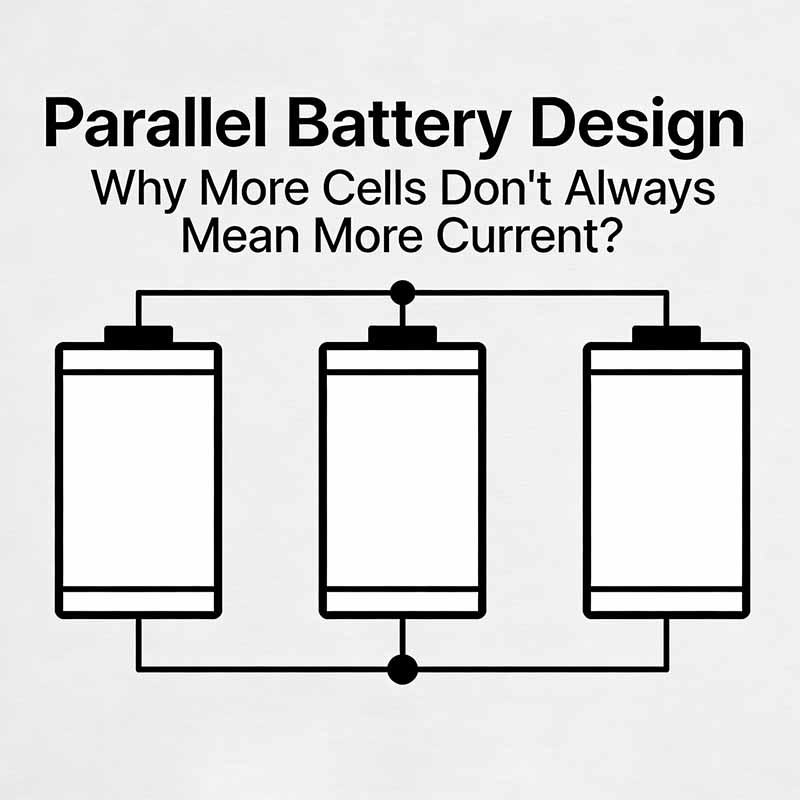
Parallel Battery Design: Why More Cells Don’t Always Mean More Current?
When designing high-power equipment, it’s easy to fall for a bit of “simple math” logic:
“If one battery cell delivers 10A, then 10 cells in parallel should easily give me 100A, right?”
In the world of actual device applications—where reliability and performance are everything—“1+1” often ends up being less than 2. Simply stacking more cells doesn’t mean your output capacity will automatically scale up. Without a solid engineering strategy, you’re not just creating a bottleneck; you might be inviting safety risks.
■ Cell Consistency: The “Uneven Load” Trap
Even when cells come from the exact same production batch, they aren’t identical twins. They each have slight differences in Internal Resistance (IR). This is the main reason why your “on-paper” current rarely matches reality.
The Problem of the Path of Least Resistance:
Electricity is lazy—it naturally rushes toward the cells with the lowest resistance. This means a few cells end up doing all the “heavy lifting,” getting overworked and overheating, while the rest are barely contributing.
As you add more cells to the mix, keeping everything balanced becomes exponentially harder. One “weak link” or aging cell can disrupt the entire group, dragging down the efficiency of the whole pack.
■ BMS Constraints: The Digital Ceiling
Think of the Battery Management System (BMS) as a safety gatekeeper. Its primary job isn’t to help you go faster; it’s to make sure nothing explodes.
Why does the BMS hold you back?
Even if your cells can theoretically handle 200A, your system is hard-capped by the hardware inside the BMS, like the MOSFETs or shunts.
To prevent localized overheating or dangerous over-discharging, engineers set conservative safety limits. A common mistake we see in equipment design is pairing a massive, high-capacity cell array with an undersized BMS that simply wasn’t built to handle the peak discharge.
■ Wiring & Connectors: The Physical Bottleneck
Before power even reaches your device, it has to travel through busbars, wires, and connectors. These are often the most overlooked “weak links” in the entire chain.
Voltage Sag and the “Small Pipe” Problem:
Using wires that are too thin (wrong AWG) leads to Voltage Sag. Essentially, you lose energy as heat before it ever gets to your machine.
Then there’s the connection itself. The quality of the laser or spot welding determines how much heat builds up at the source. If your output plug is only rated for 50A, trying to push 100A through it will eventually melt the connector—no matter how many cells you have inside.
📌 Pro Tip: Your system’s power is always limited by the smallest “pipe” in the flow.
■ Thermal Management: The Enemy of High Current
In compact battery packs, heat is the ultimate performance killer. This is often the factor that catches designers off guard.
Heat Accumulation & Power Loss:
According to Joule’s Law, if you double the current, you don’t just double the heat—you quadruple it.
When cells are packed tightly together without proper airflow gaps or active cooling, heat builds up fast. Once the core temperature hits the BMS safety limit, the system will either shut down entirely or force your equipment into a low-power “limp mode” to stay safe. “More cells” in a tight space often just leads to “faster overheating.”
■ Summary: It’s Engineering, Not Just Math
Getting high-current output right is a System Engineering challenge. You can’t just keep adding batteries and hope for the best. To get stable, reliable power, you have to balance four key things:
- Matching Cell IR: So every cell shares the load equally.
- BMS Redundancy: Giving your management system enough “room to breathe.”
- Heavy-duty Interconnects: Minimizing energy loss through wires and plugs.
- Smart Cooling: Keeping the heat away from the core.
■ Optimize Your High-Power Battery Design
If you are developing a device that demands high-burst or sustained power, don’t leave it to guesswork. We’re here to help you engineer it right from the start. We offer:
- Custom Busbar Engineering: Low-resistance paths to maximize efficiency.
- Industrial-Grade BMS Integration: Built for heavy discharge profiles.
- Thermal Simulation: Identifying and fixing hot spots before they become problems.
Want a technical second opinion on your current battery design?