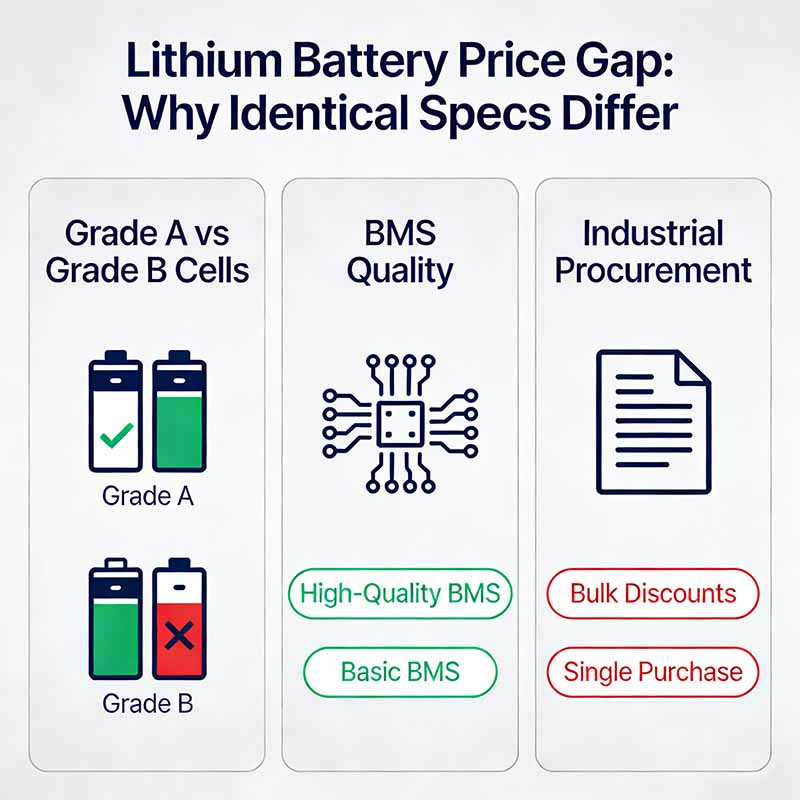
Why Do Lithium Batteries with the “Same Specs” Have Such Huge Price Gaps?
When sourcing lithium batteries, many procurement specialists and engineers run into a confusing scenario:
“Both battery packs are labeled 48V 100Ah and look identical on the outside.
Why is one quoted at $800 while the other is $1,500?”
In the lithium battery industry, on-paper specifications (like voltage and capacity) are just the tip of the iceberg. The differences you can’t see are what determine whether a battery is a reliable power tool or a “ticking time bomb.” Today, we’re breaking down the five hidden truths behind these price gaps.
■ Battery Cells: It’s Not Just the Brand, It’s the “Grade”
Cells account for about 70% of the total cost of a battery pack. This is where the price gap begins.
- Tier 1 vs. Small Labs: Top-tier brands (like CATL, EVE, or Gotion) offer superior consistency and safety, which naturally comes at a premium.
- Grade A vs. Grade B: This is the industry’s biggest “gray area.” Grade A cells meet every performance standard. Grade B cells are those rejected due to slight capacity shortfalls, high self-discharge, or cosmetic flaws. Low-cost packs often use these “downgraded” cells. You won’t notice a difference in week one, but within six months, the capacity will plummet.
- Recycled Cells: Some ultra-low-cost providers even use “second-life” cells salvaged from retired electric vehicles, which carry significantly higher failure risks.
■ BMS: The Brain’s Build Quality
The Battery Management System (BMS) is the guardian of your battery. A cheap BMS is the fastest way to a system failure or fire.
- Hardware Specs: To handle a 100A continuous discharge, a cheap BMS might use 6 low-cost MOSFETs that run dangerously hot. A high-quality BMS uses 12 or more premium MOSFETs paired with large heat sinks.
- Advanced Features: Low-end boards only offer basic over-charge/discharge protection. High-performance BMS units include precision thermal sensors, active balancing, and communication ports (CAN/RS485) to talk to your equipment.
Bottom Line: A poor-quality BMS is like a distracted driver—it won’t hit the brakes until it’s already too late.
■ Validation: Are You the First Person to Test It?
Many budget manufacturers skip rigorous testing to save on electricity and labor costs.
- Full-Cycle Aging Tests: Professional manufacturers perform complete charge and discharge cycles on every pack to verify that the “100Ah” on the label is actually inside the box.
- The Cost of Certainty: Proper testing requires expensive equipment and time. If the price is unbelievably low, the manufacturer likely skipped these steps, essentially making you their quality control tester in the field.
■ Engineering Margins: “Bare Minimum” vs. “Built to Last”
In engineering, “just enough” is often a recipe for disaster.
- Overload Design: If your device draws 100A, a budget battery is designed to hit its limit at 101A. A high-quality build is engineered to a 150A or 200A standard, utilizing thicker busbars, heavy-duty connectors, and premium wiring.
- Structural Integrity: Is the internal housing flame-retardant? Is there enough spacing for heat dissipation and shock absorption?
- Long-term Reliability: Batteries built with a “margin of safety” run cooler. Components age slower, and the failure rate stays near zero over the years.
■ Supply Chain Stability: Buying Once vs. Buying for a Decade
Most industrial equipment has a long lifecycle. Knowing you can get the same battery in three years is vital.
- Standardized vs. Scavenged Parts: Low-cost shops buy whatever cells are cheapest that week. This means the battery you buy today might have completely different internal components than the one you order next year, making maintenance a nightmare.
- Long-term Support: Premium suppliers maintain stable supply chains and offer technical support for 5 to 10 years. That “certainty” is part of what you are paying for.
■ Summary: Lithium Batteries are a “Long Run” Product
When buying lithium, don’t look at the purchase price; look at the Operating Cost.
A cheap battery that lasts one year and causes an unexpected shutdown is far more expensive than a high-quality battery that runs for five years maintenance-free.
“If you think professional advice is expensive, try the cost of an amateur.”
■ How We Balance Performance and Value
We insist on Grade A cells and build every pack with significant safety margins. If you need a transparent comparison based on your specific application, our engineers are ready to help.
- Request a Cell Grading Report
- Deep-dive into our BMS Protection Logic
- View Real-world Product Test Data