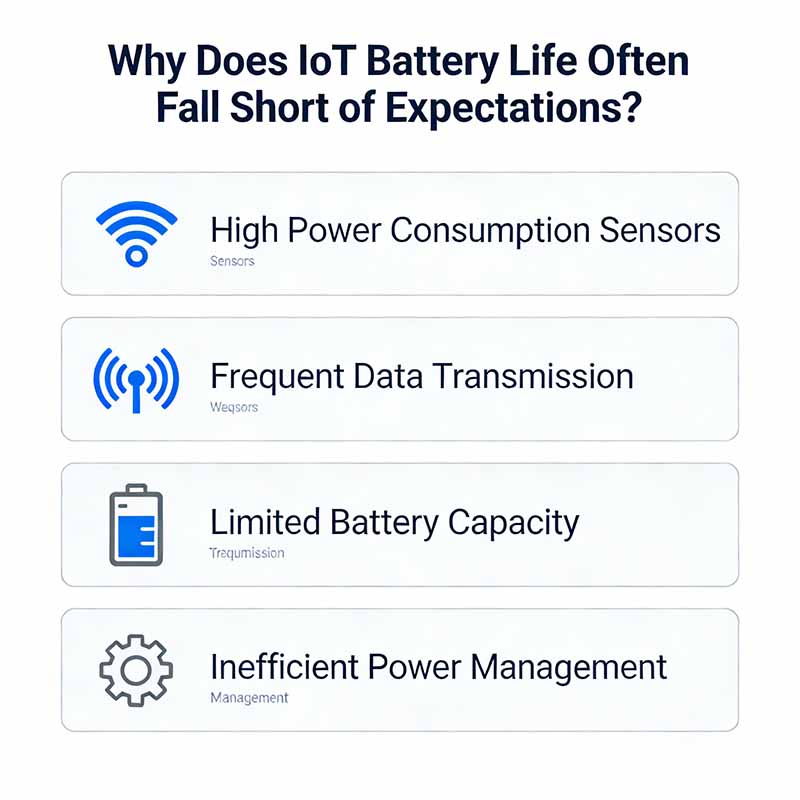
Why Does IoT Battery Life Often Fall Short of Expectations?
In IoT project development, one of the most frustrating challenges is the “power gap”: a sensor rated for 3 years of service life often goes offline within six months due to battery exhaustion.
The power logic of IoT devices is fundamentally different from standard consumer electronics. They typically operate in a “deep sleep, high burst” cycle. To customize an efficient battery pack for IoT, we must strike a delicate balance between energy density, self-discharge rates, and pulse discharge capability.
■ The “Heartbeat” Power Profile of IoT
Most IoT devices—such as remote sensors, GPS trackers, and industrial data collectors—exhibit a distinct “spiky” current profile:
- Sleep Mode: 99% of the time, the device is dormant, drawing current in microamps (μA). Here, the battery’s self-discharge rate is the deciding factor.
- Active Mode: The device wakes up to collect data or process information, with current rising to milliamp (mA) levels.
- Transmission: Data is sent via NB-IoT, LoRa, or 5G. This creates instantaneous high-pulse currents that test the battery’s C-rate performance.
📌 Think of an IoT device as a “lurker.” It stays motionless for long periods but must push open a heavy door (send data) at fixed intervals. If the battery lacks the pulse strength, the device won’t “open the door” even if it has plenty of energy stored deep inside.
■ Core Selection: Which Chemistry Fits Your IoT Scene?
The choice of cell determines the final product’s footprint and longevity. Here is a comparison of the three mainstream solutions:
| Feature | Li-Polymer (Li-Po) | 18650/21700 Cylindrical | Li-SOCl2 (Primary) |
|---|---|---|---|
| Energy Density | High (Thin/Light) | Moderate | Extremely High |
| Cycle Life | 300-500 (Rechargeable) | 500-1,000 (Rechargeable) | Single-use (Non-rechargeable) |
| Self-Discharge | ~5% / Month | ~2% / Month | <1% / Year |
| Typical Use | Wearables, Handhelds | Smart Gateways, Robotics | Water Meters, Remote Sensors |
| Key Advantage | Customizable shapes | Low cost, Standardized | 10-year life, Extreme Temp |
■ Three Critical Challenges in IoT Battery Design
1. The Conflict Between Size and Capacity
IoT devices demand miniaturization. Lithium Polymer (Li-Po) is often the first choice because it can be customized in length, width, and thickness to fit the housing. However, if the device is deployed outdoors and space allows, cylindrical LiFePO4 cells offer superior safety and thermal stability.
2. The “Voltage Trap” of Pulse Current
Many IoT devices experience a sharp voltage drop during signal transmission. If the BMS over-current threshold is set too tight, or the cell’s internal resistance is too high, the device may trigger a low-voltage shutdown exactly when it tries to send data.
- Solution: Parallel supercapacitors at the battery terminal or select high-rate cells capable of sustaining high pulse loads.
3. Harsh Environmental Demands
Outdoor deployments (e.g., agricultural monitoring) face extremes from -20°C to 60°C.
- Cold Start: Internal resistance spikes in low temperatures, often failing to provide enough startup current.
- Heat Aging: Continuous exposure to high heat accelerates chemical degradation and capacity loss.
■ BMS Optimization for IoT Applications
A qualified IoT-specific BMS is more than just a protection circuit; it is an energy manager:
- Ultra-low Quiescent Current: The BMS self-consumption must be in the μA range. Otherwise, the protection board itself will drain the battery while the device is sleeping.
- Precise SOC Estimation: For LiFePO4 batteries with flat discharge curves, an accurate Coulomb counter is essential to prevent “false” low-battery alerts.
- Adaptive Temperature Thresholds: Protection limits should be customized based on the specific deployment environment to maximize uptime.
■ Summary: Choosing the Right Battery for Your Project
- Frequent Charging Needed (e.g., Smartwatches, Handheld Terminals): Choose Li-Po (Lithium Polymer).
- Outdoor Long-term with Power Input (e.g., Solar-powered Security): Choose LiFePO4 Battery Packs.
- 5-10 Year “Fit and Forget” Deployment (e.g., Smart Meters, Asset Tags): Choose Li-SOCl2 (Lithium Thionyl Chloride).
■ Get Professional Technical Support
Poor battery selection leads to high field maintenance costs. Our application engineers can help you match the most cost-effective cell chemistry to your specific power profile.
- Access discharge simulation data for various environments.
- Customize ultra-low-power BMS protection circuits.
- Design custom-shaped battery stacks for compact enclosures.